PhysicsChart.com
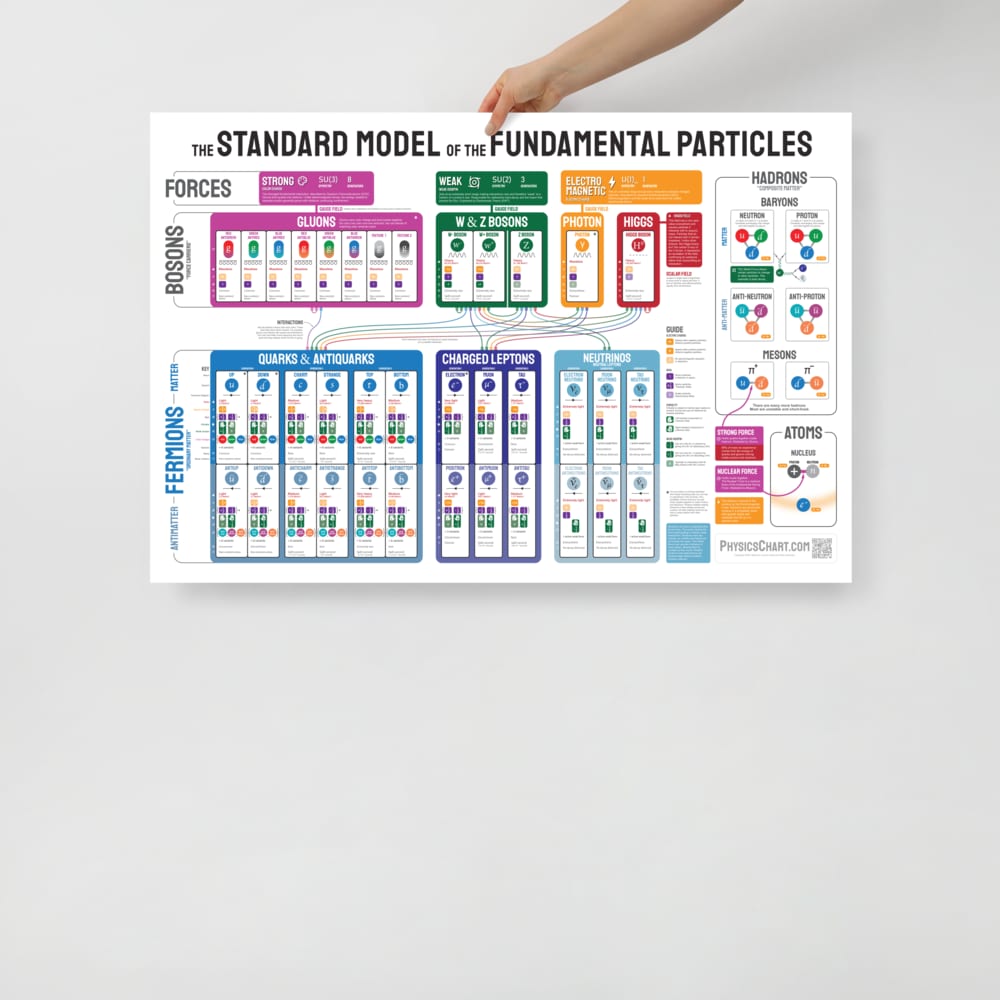
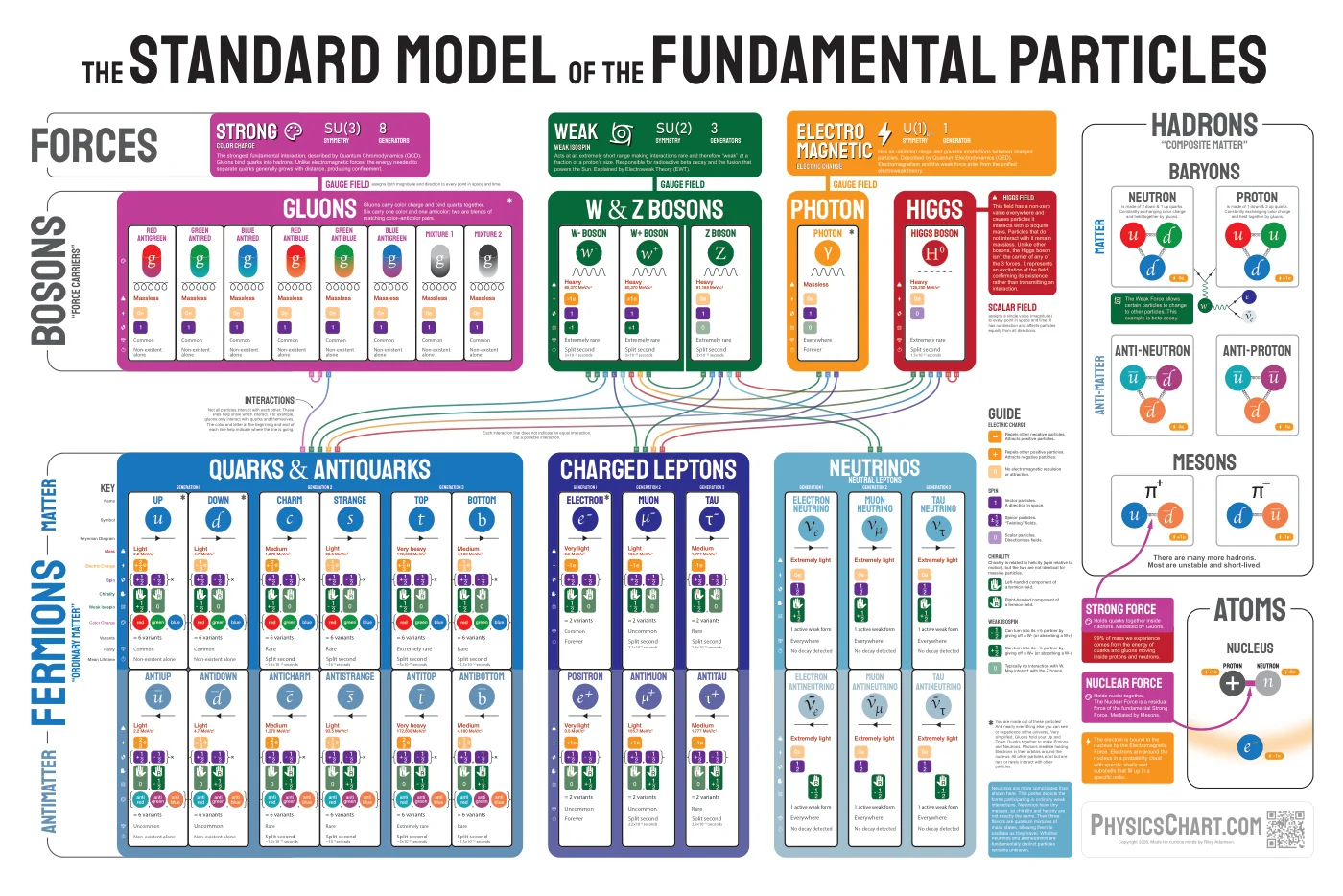
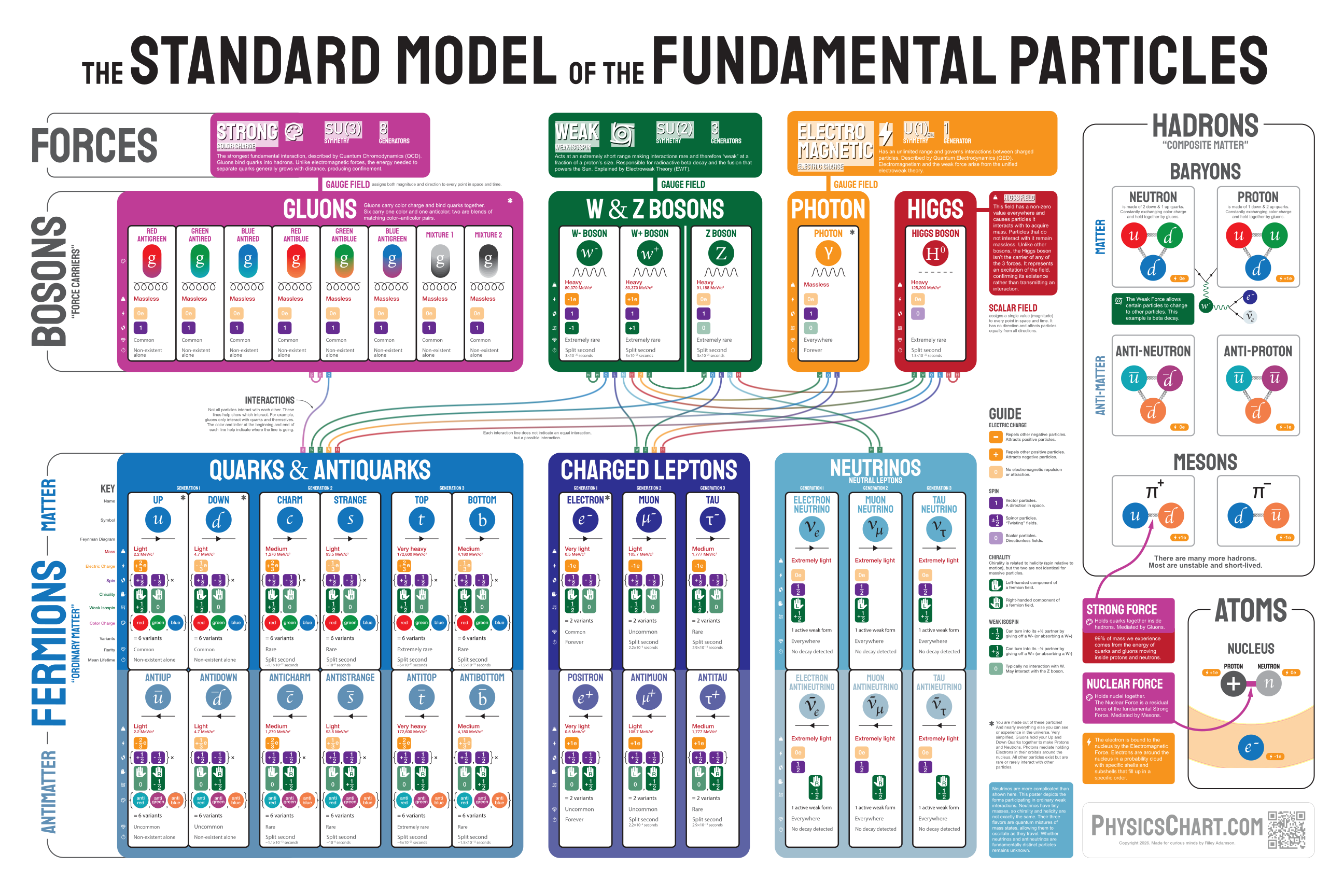
The Standard Model of the Fundamental Particles poster: three forces across the top, the gluons, W and Z bosons, photon and Higgs beneath them, then quarks, charged leptons and neutrinos with their antiparticles, joined by interaction lines. Hadrons and atoms run down the right.

Click any particle, force or sectionTap anything on the chart

The Standard Model, v64

Every fundamental particle.
One chart.

Nearly everything you can touch is built from three particles: the up quark, the down quark and the electron. The chart shows the rest, and how they all interact.

37
particle cards
18
interaction lines
3 + 1
forces, and the Higgs field

Take it home

Three feet wide, on your wall.

A hand pinning the 24 by 36 inch Standard Model poster to a white wall; the poster is several hand-spans wide.
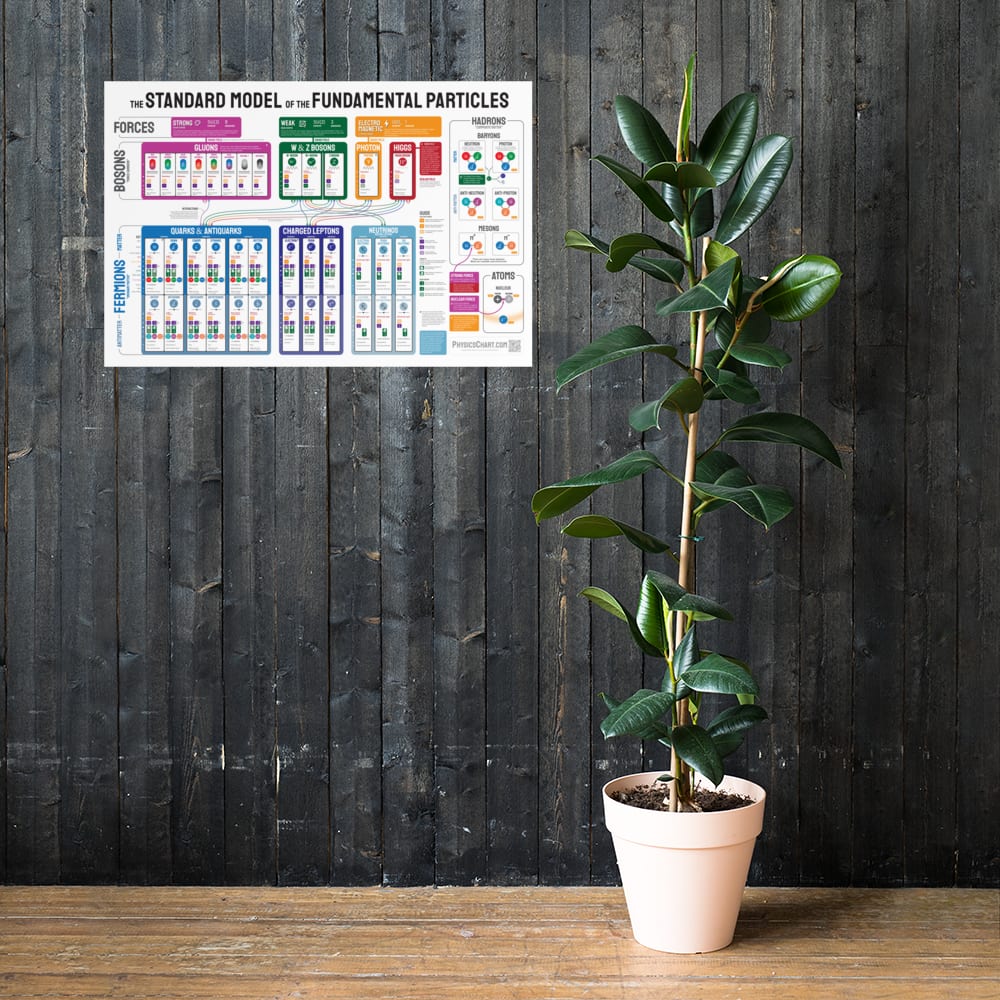
The poster on a dark wood-plank wall beside a tall rubber plant.
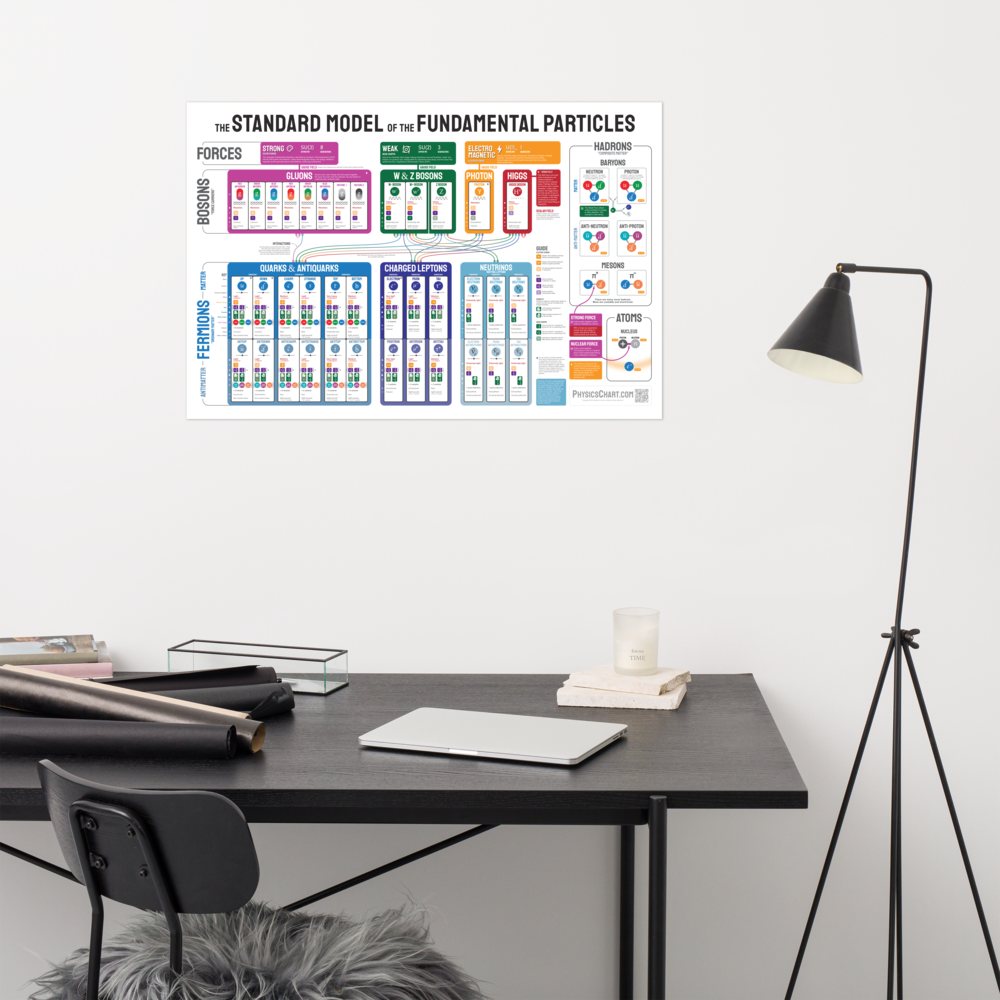
The poster on the wall above a desk with a lamp, notebook and chair.
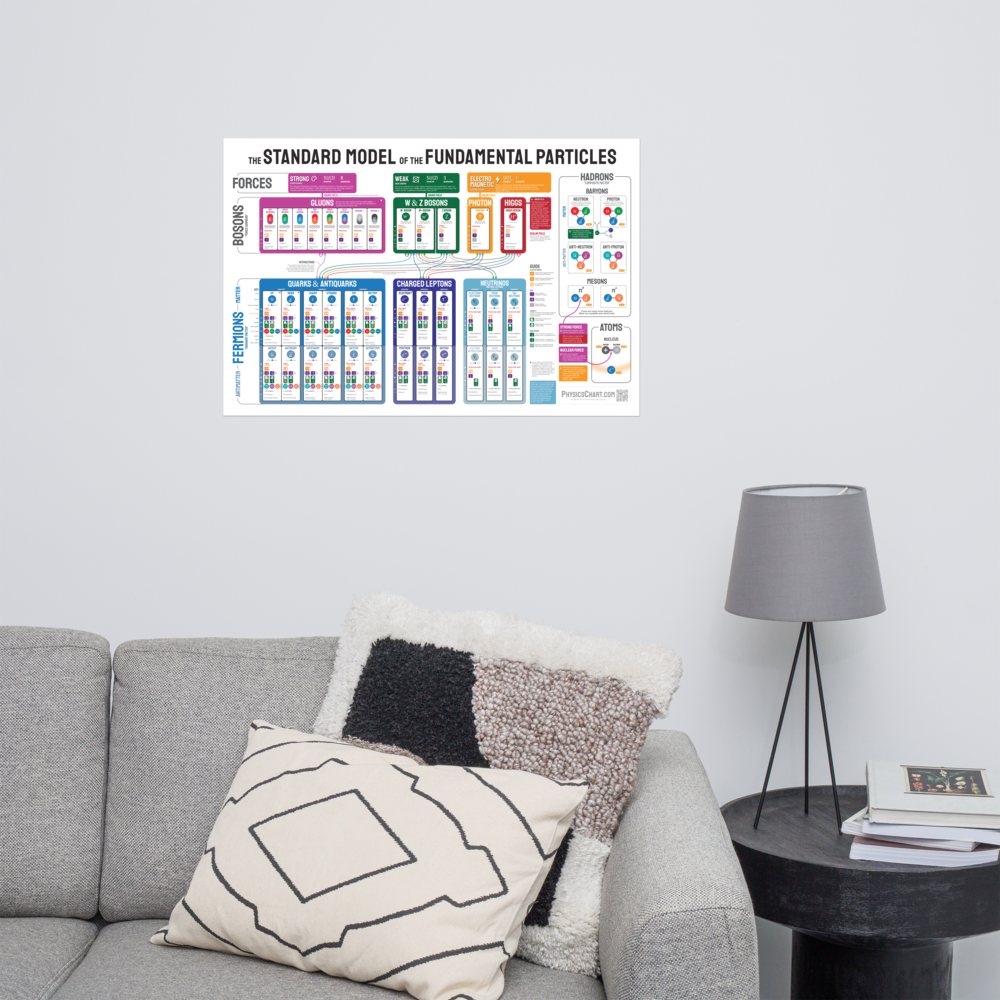
The poster above a gray sofa with cushions and a side lamp.
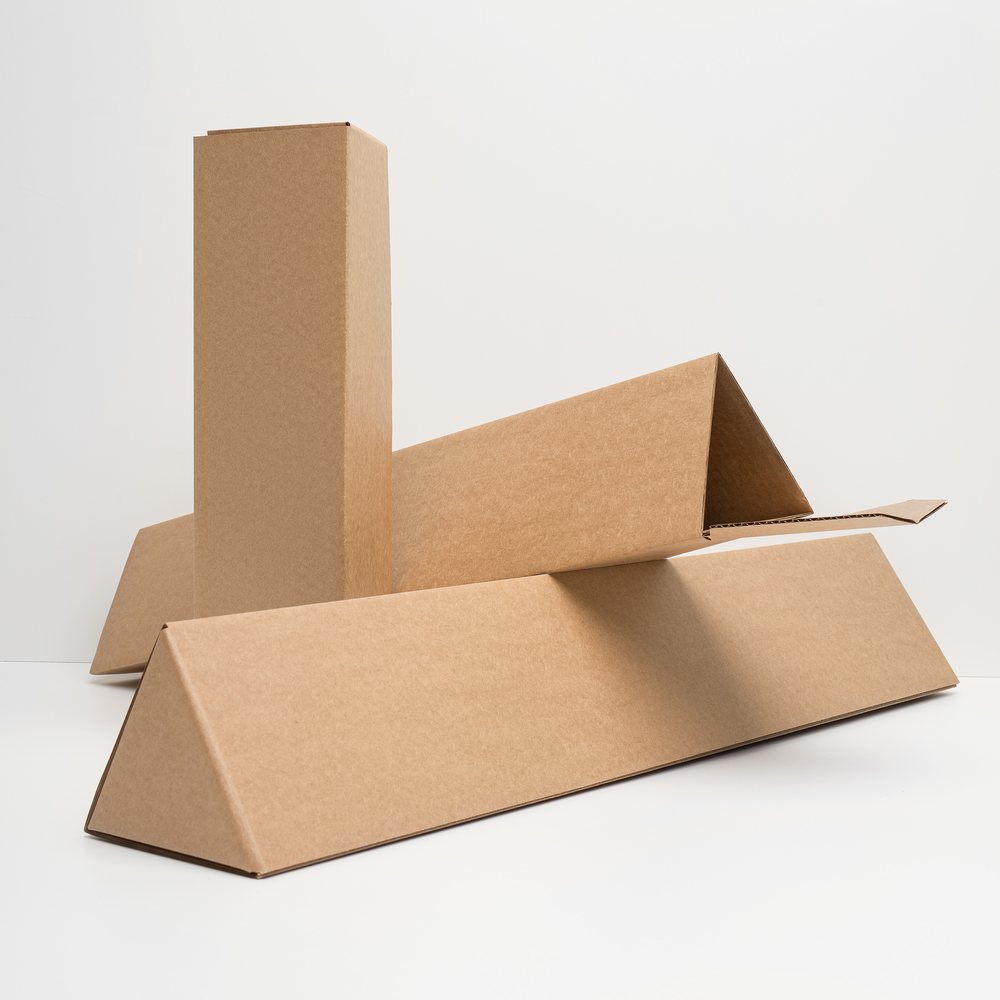
The flat cardboard mailer the poster ships rolled inside.
Ships rolled

The print

The poster

  • 24 × 36 inches, landscape
  • Museum-quality matte paper, 189 g/m² — no glare under a lamp
  • 10.3 mil thick, 94% opacity, paper sourced from Japan
  • Printed when you order it and shipped rolled, worldwide
  • Usually on its way in two to five business days
  • $7.99 shipping in the US
  • Damaged in the mail? I’ll send a new one, free

Order by December 10 for Christmas delivery in the US.

The download

The PDF

  • The same chart, to print yourself at any print shop
  • Vector PDF: sharp at any size
  • Plus two JPGs, 5000 px and 2592 px wide
  • Yours the moment you check out

Riley Adamson, who designed the chart

Who made this

Riley Adamson

Salt Lake City, Utah

This poster is designed to be the “Periodic Table of Fundamental Particles.” The goal is to show all of the particles and help indicate how they relate to each other. Just like the Periodic Table of Elements doesn’t teach all of chemistry, this doesn’t teach all of the Standard Model, but it gives a broad map of key relationships and principles to build from.

My background is in design, and I’ve always admired those who grasp the intricate math behind quantum mechanics. In another universe, I’d like to think I pursued physics and made meaningful contributions to its advancement. In this universe, I wanted to contribute in the best way I could: by visualizing the relationships between fundamental particles.

I’m not a particle physicist, so if you spot any errors or have suggestions for improvement, I’d greatly appreciate your input.

Version 64, checked line by line against the Particle Data Group's 2024 values. Part of the RileyAdamson.com family of projects. Spotted an error? Tell me.
Your cart

Your cart is empty.